

- 18 Απρ 2022, 15:56
#760177




https://www.coolerfuture.com/blog/tesla-sustainability
@ Ιλον.
Με καλεσες;

Α καλα, θα ηταν ο Μαρκω Βαγγος τοτε.
markvag έγραψε:Για δες τους ρύπους στο σύνολο της ζωής του οχήματος.

A study by the German Federal Ministry for the Environment, Nature Conservation and Nuclear Safety examined the environmental balance of gasoline, diesel and electric vehicles over their entire lifespan (production, use and disposal). What they found was that the production of electric cars – mainly due to their batteries – causes a lot more greenhouse gases at first, but after a few years, EVs are significantly more environmentally friendly than vehicles with classic combustion engines.
In fact, the total greenhouse gas emissions of an electric vehicle are about 30% lower than those of a gasoline vehicle and around 23% lower than those of a diesel vehicle.
But it gets even better.
In a country like China, for example, where a lot of electricity is still generated by coal, the production and operation of electric cars is much more harmful than, say, in Norway, where the focus is on renewable energy.
Now that you know these facts about electric car emissions, here’s some controversial food for thought:
Even if it’s not in Tesla's hands which electricity is used to power their cars, they can still decide where they want to manufacture them and hence which energy sources they ultimately use.
Right now, Tesla is planning to have new factories – an expansion in China and a completely new Gigafactory in India. China gets 56.8% of its energy from coal, India also relies heavily on coal and is even building new coal plants despite climate change.
So while Tesla claims it is all about “saving the world”, are these the most environmentally-friendly locations to build a factory?
Yet, apart from the energy needed to produce them, there’s also a need for rare metals.
Approximately 13 kilograms of cobalt and lithium are needed to produce a battery with a capacity of 90 kilowatt hours. (For reference: Tesla's Model S has an 83 kWh battery.)
This poses a number of issues with Tesla being green.
According to a 2015 study, the production of electric vehicles could easily deplete 74-248% of the world's lithium reserves by 2050 (two different scenarios were used to calculate, therefore the different numbers). Cobalt reserves could also be depleted by 50%.
Naturally, it begs the question of whether this type of production can really be so sustainable when there is a resource constraint for essential components of the batteries.
In addition, large quantities of toxic chemicals are used in the extraction of lithium. In an article published by Wired, it is described that the soil, which contains lithium, is thus heavily contaminated – and this is despite the fact that only 0.2% of the affected soil contains the valuable metal. The other 99.8% destined to be contaminated with toxic chemicals is dumped back into the environment. In Bolivia, Chile and Argentina, known as “the lithium triangle”, this has led to huge environmental problems like soil contamination and water shortages.
In addition to lithium, Tesla also needs cobalt for their EVs, which they mine in the Democratic Republic of Congo alongside other tech giants like Apple, Dell and Microsoft. There, cobalt mining is linked with severe (and multiple) human rights violations. And yes, we’re talking children as young as 6 mining cobalt for Tesla’s EVs for $3 a day.
So this we can conclude: Just by mining rare metals, Tesla already violates not one but several of the Sustainable Development Goals.
But the list of Tesla’s problems doesn’t stop there. In addition to the rare metal issue, there is another important one: water.
According to German media reports, Tesla’s new Gigafactory that is currently being built in Brandenburg, Germany will consume an incredible amount of water.
To be precise: the Brandenburg factory will consume about 3.6 million cubic metres of water per year, which is roughly 30% of the total water in the region. According to experts, this could even lead to a water shortage.
After Tesla finally made it into the S&P 500 ESG Index this May, the company was promptly kicked out of a major sustainability fund in early June. BetaShares, a major AUD17.5-billion Australian fund manager, removed Tesla from their sustainability portfolio after the company fell foul of controversy screens because of labour and environmental concerns – but failed to provide any explanation or information.
These included the above-mentioned Gigafactory in Brandenburg, but also Musk's decision to re-open the factory in California against the COVID-19 requirements, a decision that reportedly led to 450 people being infected.
Tesla’s lack of communication and transparency, which has ultimately led BetaShares to doubt the company, is a lasting criticism of the car manufacturer.
The Transition Pathway Initiative, a global initiative that assesses companies’ preparedness for the transition to a low-carbon economy, gave Tesla a score of zero back in December 2017 (0 being the worst; and 5 the best). The zero score is typically reserved for companies that are "unaware of (or not acknowledging) climate change as a business issue." Alarming, right?
You might think “ah well, that’s more than three years ago, things must’ve changed!”.
Apparently, things haven’t changed too much: At the time of writing this article, Tesla has still got just one point only:
https://www.coolerfuture.com/blog/tesla-sustainability
@ Ιλον.
Με καλεσες;
Α καλα, θα ηταν ο Μαρκω Βαγγος τοτε.
He who makes a beast of himself gets rid of the pain of being a man.
https://www.youtube.com/watch?v=pL_YEsJsFEY
https://www.youtube.com/watch?v=pL_YEsJsFEY



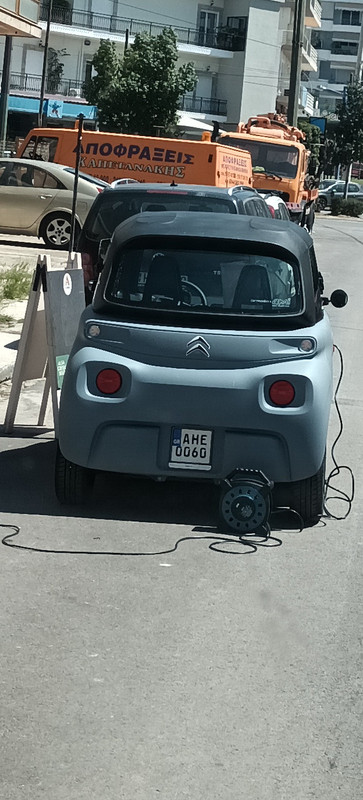

 και θελει και 5,5 χιλιαρικα;

