Για θέματα γενικού ενδιαφέροντος, εκτός μηχανοκίνητων...
Άβαταρ μέλους
By j.marr
#129738
giannik1977 έγραψε:Παντως εδω κ 2 μερες εχουν εξαφανισθει ορισμενοι απ την αριστερη πτερυγα του petrolheads.gr... :twisted:
Ρε σεις βγειτε , μιληστε , πλακα κανουμε μεταξυ μας , ολοι στο ιδιο καζανι βραζουμε.. :oops:


Για μπάνιο πήγανε ρε.
Άβαταρ μέλους
By nass
#129739
Corto Maltese έγραψε:
EDDIE_147 έγραψε:Malteze είμαι ο τελευταίος που θα υπερασπιστών την Τσιπρον αλλά μην ξεχνάς ότι ή πουτσα (sic) που φαγανε πρόσφατα οφείλεται σε εμάς. Ή αλληλεγγύη γενικά είναι μια ωραια λέξη που αρέσει στο συριζα.
Κατά τ'αλλα για το ευρώ μην είσαι τόσο σίγουρος.

Η πούτσα που φάγανε πρόσφατα οφείλεται σε έναν Έλληνα επιχειρηματία και όχι στην Ελλάδα ως κράτος.


Ελληνας επιχειρηματίας έριξε έξω την Τράπεζα Κύπρου ?
Άβαταρ μέλους
By Zorz
#129744 http://www.philipatticus.com/2015/06/al ... endum.html

Greek Prime Minister Alexis Tsipras has just called for a referendum in Greece, to be held on Sunday, 5 July. The topic of the referendum will be a “yes or no to the austerity measures proposed by the creditors”.
Essentially, the real question here is “in or out of the Euro”, or even “in or out of Europe”.
This is a canny political move on his part. It is the only way his political party can be absolved of the blame for misleading voters with the “Thessaloniki programme” and for the disastrous record of governance since SYRIZA’s election on January 27th.
But at the same time, it is probably the right move to make. Greece’s creditors have been insisting on exceptionally foolish policy measures. Despite their denials and counterproposals, they have at various points in the negotiation wanted value added tax on electricity, processed foods and tourism to rise to 23%. This is an extremely regressive move, particularly given the fact that Greece has been in recession since 2009, i.e. in economic depression.
I was amused (for lack of a better word) to see Christine Lagarde, head of the IMF, state in an interview that the Greek reform proposals cannot be based “only on tax increases”. That was her rationale for rejecting higher taxes on companies. Instead, the IMF recommended higher consumption taxes, on a population that has seen a 25% reduction in real GDP, a 27% unemployment rate, and skyrocketing poverty rates. Obviously, there is more than one deep contradiction to such a policy.
But this is also probably the right decision because there is still no political consensus in Greece on what the root causes of the problem/s are, and what measures should be taken in response. Greek voters believed SYRIZA’s promises to redistribute wealth through higher government spending, despite all evidence to the contrary. In the months since SYRIZA has been elected, the population has become even more polarised, while government ministers and supporters have been making increasingly outlandish and often very offensive statements.
This is the time for every voter to make up their minds what they want, and what they believe in. Hopefully, they will be accurately informed as to the loan conditionality on the table, and will be able to understand its consequences.
It will also be important to understand what a “no” vote means:

Immediate capital controls to prevent a bank run: these are now probably from Monday, 29 June;
A cut-off of any new bilateral or multilateral funding for Greece, both in terms of loan refinancing as well as from EU structural funds;
A massive smear campaign in European and international press: what has been seen until now will be child’s play compared to what is coming. Part of this will be deliberate misinformation, but most of it will be genuine frustration and misunderstanding by other European citizens;
A likely political embargo. Greece and its elected representatives will be treated as pariahs by other the European Union Member States;
Tourism cancellations: a bank run and credit controls at the height of the tourism season can only be considered a massive policy failure by the Greek government;
A cessation or cancellation of export and import contracts involving Greek companies;
The public sector budget will fall still further, as individuals and companies are unable to pay their already-high taxes;
Payments of mortgages and loans will cease;
A consolidation of power by SYRIZA and ANEL, given their control over the public purse. How long this can last is unknown.

I have covered the likely impacts of a Grexit here. I assume that we are still in the first scenario: Grexit but remaining within the Eurozone.
Less than one hour after the referendum announcement, lines were forming outside bank ATMs and gas stations across Athens. I was in one of them.


http://coppolacomment.blogspot.co.uk/20 ... risis.html

I know I keep saying that economics is not a morality play. But when it comes to Greece, I can find no other satisfactory explanation for what is going on.

The harsh treatment meted out to Greece over the last five years makes no economic sense whatsover. It has driven Greece into a deep depression that not only makes its government budget unsustainable but renders its debt unpayable: it has not only caused poverty and distress among Greece's population, but it has driven businesses into bankruptcy and done serious damage to the supply side of Greece's economy. And yet creditors want more.

I might agree that reforms to pensions are a good idea. I might also agree with widening the tax base. But not, emphatically not, in an economy as depressed as this. What is needed is debt relief, FIRST. Then real reforms, and help to restore the wanton destruction caused to the economy through ill-considered and frankly vindictive austerity measures.

But debt relief is not on the agenda. The IMF has previously expressed concern about the sustainability of Greece's debt: but now, returning to the fray after a brief absence, it has compromised its own objectives in order to present a united front with the EU. The Greek side is still asking for debt relief, though not for debt reduction. But its pleas are falling on deaf ears. The reunited Troika continues to insist on austerity measures as a condition of releasing the bailout funds previously agreed.

I've reminded everyone before about Irving Fisher's famous observation: "The more the debtors pay, the more they owe". In 2012, Michael Hudson developed this idea further. "Debts that can't be paid, won't be", he said. And he went on:

Today’s financial trend threatens to reverse this pro-debtor reform tendency. Without acknowledging the economic and social consequences, the “business as usual” approach is a euphemism for sacrificing economies to creditors. It seeks to legitimize the disproportionate gains of banks and their rentier partners who have monopolized the past generation’s surplus...... The aim in practice is to impose austerity and economic shrinkage on the private sector, while the public sector sells off its assets in a voluntary pre-bankruptcy.

The internal contradiction in this policy is that austerity makes the debts even harder to pay. A shrinking economy yields less tax revenue and has less ability to create a surplus out of which to pay creditors. Debt repayment is not available for spending on current goods and services. So markets shrink more.

If what you want is debts paid back, austerity is bad medicine.

But I said this was a morality play. The standard story goes that lazy, ne'er-do-well Greeks borrowed and spent excessively to support a lavish lifestyle well beyond their means. And to make matters worse they lied about their true financial position in order to gain admission to the Euro club. Unsuspecting German and French banks lent to them believing they were financially in better shape than they actually were. And when the Greeks finally admitted they couldn't actually pay the money back, hard-working thrifty Germans had to bail them out. Now the Greeks are complaining about the reforms that the virtuous Germans and saintly official creditors are requiring of them. But they are only pretending to do reforms, In reality they are still shirking. No wonder the creditors' patience has run out. The Greeks just can't be trusted.

I hear this story a lot. But it's not true. And even if it were, it would not be helpful. It could equally be argued that Greece was sold a lie by the promoters of the Euro, since it was led to believe that Euro membership was the path to future prosperity. How was it to know that the abject failure of France, Germany and the UK to control their banks meant that naive Greeks would be at the mercy of predatory lenders? See, it looks different framed like that, doesn't it? And it is a bit rich to regard the official creditors as "saintly", too. They lent foolishly, in contravention of their own rules, to banks that had lent profligately and gained disproportionately. In so doing, they became what Hudson describes as "rentier partners" to those banks. Why should they not now take the losses that they should have inflicted on the banks in 2010?

The constant presentation of Greeks as intrinsically untrustworthy is profoundly damaging to the social cohesion of Europe. Unpayable debts do not arise from moral defect: Greeks are no more untrustworthy than anyone else. I do wish Germans would remember their own history. It is not so long since Germans were regarded in much the same way as Greeks are now. This is Keynes describing the attitude of the French statesman Clemenceau to Germans:

He was a foremost believer in the view of German psychology that the German understands and can understand nothing but intimidation, that he is without generosity or remorse in negotiation, that there is no advantage he will not take of you, and no extent to which he will not demean himself for profit, that he is without honour, pride or mercy. Therefore you must never negotiate with a German, or conciliate him; you must dictate to him. On no other terms will he respect you, or will you prevent him from cheating you.

The Economic Consequences of the Peace, III.7

Germany was loaded with unpayable reparations after World War I partly because of attitudes like these...... and we all know where that led, don't we?

Brian Lucey reminds us that after World War II, Germany was forgiven the majority of its debt. It also received aid from the US to restore its economy - the Marshall plan. Yet now it refuses to consider further debt relief for Greece, let alone aid. Instead, it insists on harsh austerity measures, even though they make it even less likely that Greece will pay its debts. This, coupled with the disparaging language that is routinely used about Greeks and the wilful ignoring of their terrible economic plight, smacks of a desire to inflict punishment rather than any genuine interest in reform.

But punishing people - or nations - for running up unpayable debts actually doesn't sit well with a moral stance, particularly one that is supposedly founded on Christian values. Jesus has quite a bit to say on unpayable debts:

The kingdom of heaven is like a king who wanted to settle accounts with his servants. As he began the settlement, a man who owed him ten thousand bags of gold was brought to him. Since he was not able to pay, the master ordered that he and his wife and his children and all that he had be sold to repay the debt. At this the servant fell on his knees before him. 'Be patient with me,' he begged, 'and I will pay back everything.' The servant's master took pity on him, cancelled the debt and let him go.

But when that servant went out, he found one of his fellow servants who owed him a hundred silver coins. He grabbed him and began to choke him. 'Pay back what you owe me!' he demanded. His fellow servant fell to his knees and begged him, 'Be patient with me, and I will pay it back.' But he refused. Instead, he had the man thrown into prison until he could pay the debt.

When the other servants saw what had happened, they were outraged. They went and told their master everything that had happened. Then the master called the servant in. 'You wicked servant,' he said. 'I cancelled all that debt of yours because you begged me to. Shouldn't you have had mercy on your fellow servant just as I had on you?' In anger his master handed him over to the jailers to be tortured, until he should pay back all he owed.

Matthew 18:21-35, NIV

I'm not at all sure what Jesus would have to say about the treatment of Greece by its creditors. Whatever happened to forgiveness?


Και τους 2 τους παρακολουθώ εδώ και καιρό, και πάντα γράφουν ιδιαίτερα εύστοχα.
Άβαταρ μέλους
By manosky
#129751 "Ο κόσμος στο δημοψήφισμα συχνά ψηφίζει υπέρ ή κατά εκείνου που θέτει το ερώτημα και όχι υπέρ ή κατά μιας απάντησης στο ερώτημα"

Χέλμουτ Κολ


Τρομερή ατακιά
Άβαταρ μέλους
By j.marr
#129755
giannik1977 έγραψε::inlove: :inlove: :inlove:
http://www.zougla.gr/parapolitiki/artic ... mopsifisma


Μπήκε και πρίν.

Α ναι. Ποιος είναι αυτός που ελεγε οτι δεν θα πέτσωνε την φακλανίτσα του LSE που ποστάρανε χτές. Εχει και benefits το χλάτσωμα συριζεας ως φαίνεται.

Πρώτη φορά αριστερά. :s_thumbsup
Άβαταρ μέλους
By nass
#129765
Zorz έγραψε:http://www.philipatticus.com/2015/06/alexis-tsipras-calls-referendum.html

Greek Prime Minister Alexis Tsipras has just called for a referendum in Greece, to be held on Sunday, 5 July. The topic of the referendum will be a “yes or no to the austerity measures proposed by the creditors”.
Essentially, the real question here is “in or out of the Euro”, or even “in or out of Europe”.


Δυστυχώς φοβάμαι ότι αυτό είναι το ουσιαστικό ερώτημα...

Zorz έγραψε:This is a canny political move on his part. It is the only way his political party can be absolved of the blame for misleading voters with the “Thessaloniki programme” and for the disastrous record of governance since SYRIZA’s election on January 27th.


Ορθόν

Zorz έγραψε:But at the same time, it is probably the right move to make. Greece’s creditors have been insisting on exceptionally foolish policy measures. Despite their denials and counterproposals, they have at various points in the negotiation wanted value added tax on electricity, processed foods and tourism to rise to 23%. This is an extremely regressive move, particularly given the fact that Greece has been in recession since 2009, i.e. in economic depression.


Επίσης ορθόν, η πρόταση των πιστωτών είναι απαράδεκτη :thumbsdown: 23% ΦΠΑ στη μόνη σοβαρή βιομηχανία της χώρας... πάλι καλά που πήραν πίσω το 23% στην ενέργεια :slap:

Δυστυχώς οι πολίτες ήρθαν between a rock and a hard place -και αυτό σε καμία περίπτωση δεν είναι τιμητικό για την παρούσα κυβέρνηση.
Άβαταρ μέλους
By j.marr
#129769
nass έγραψε:Επίσης ορθόν, η πρόταση των πιστωτών είναι απαράδεκτη :thumbsdown: 23% ΦΠΑ στη μόνη σοβαρή βιομηχανία της χώρας... πάλι καλά που πήραν πίσω το 23% στην ενέργεια :slap:


Το οτι αυτά ηρθαν ως απάντηση σε κοκκινες γραμμες για απολύσεις συντάξεις κλπ ΔΥ προνόμια μήπως το προσπερνάμε.
Άβαταρ μέλους
By costas80
#129771
EDDIE_147 έγραψε:
ΕΠΙΤΕΛΟΥΣ ένας ευρωπαίος αξιωματούχος για πρώτη φορά δήλωσε ότι όποιος μιλάει για έξοδο από το ευρώ απλά ψεύδεται γιατί τέτοια δυνατότητα δεν υφίσταται.


...εκτός αν η Ελλάδα με νομοθετικές διαδικασίες μπλα μπλα μπλα εκκινήσει τέτοια ιστορία.

Προσωπικά, αν και δεν τους ψήφισα (επειδή φοβόμουνα ακριβώς αυτή τη σχιζοφρένεια απόψεων) πίστευα ότι θα αντιμετώπιζαν ρεαλιστικά την κατάσταση και θα εφάρμοζαν ένα καλύτερο/δικαιότερο μνημόνιο.

Η στάση τους είναι απατεωνίστικη.
Φέρνουν ένα δίλημμα το οποίο δεν είναι σαφές, σε καθεστώς αφόρητης πίεσης και το κανόνι να περιμένει από εβδομάδα.
Και καπάκι σε όλη αυτή την ομορφιά, πιστοί στην σχιζοφρένεια απόψεων που ανέκαθεν είχαν δίνουν και ν+1 διαφορετικές ερμηνείες για το τι σημαίνει κάθε απάντηση.
Ο ένας λέει εντός ευρώ, ο άλλος λέει εκτός ευρώ.

Ρωτάνε το Λαφαζάνη τι θα γίνει αν ψηφιστεί ΝΑΙ και αυτός λέει ότι θα εξακολουθεί να διαφωνεί αλλά η συμφωνία θα εκτελεστεί χωρίς ο ίδιος να την ψηφίσει. :dizzy:
Οι έντιμοι αυτοί τύποι που παίρνουν "δύσκολες" αποφάσεις δεν τολμάνε να ψελλίσουν τη λέξη παραίτηση.

Το αστείο ( ; ) βέβαια είναι ότι συνεχίζουν να κράζουν στη Βουλή την πρόταση των θεσμών (στηρίζοντας το ΟΧΙ) ενώ αυτή έχει αποσυρθεί και από Τρίτη δεν θα υπάρχει καμία άλλη πρόταση.
Οπότε τι ακριβώς θα σημαίνει το ΝΑΙ.
ΝΑΙ είσαστε επικίνδυνοι απατεώνες; :hmmm:

Να συμφωνήσω εδώ με το συμφορουμιτη.
Άβαταρ μέλους
By gto250swb
#129773 http://www.theguardian.com/business/live/2015/jun/27/greek-crisis-mps-referendum-tsipras-eurogroup-ministers-live

Dominique Strauss-Kahn, who ran the IMF when the first Greek bailout was arranged, has published a ‘mea culpa’ about the mistakes the Fund made:

He’s admitted that it should have pushed other eurozone countries to do more to help Greece and fought against the push for tough austerity, admitting that it also miscalculated the impact of such “pro-cyclical adjustment”.

And while it’s too late to change that, DSK does make a case for giving Greece debt relief now - by rolling over and extending repayments due to official creditors.


εγω το μονο που εχω να τονισω ειναι το surreal του πραγματος, τη τρεμουλιαστη φωνη του Νταϊσεμπλουμ, τον Στρος Καν με απιστευτο timing να αδειαζει το ΔΝΤ και Λαγκαρντ, το Σοιμπλε να επιμενει να μην λεει τιποτα το ουσιωδες -οπως και τους τελευταιους μηνες- το γενικο μουδιασμα.

Η ΕΕ δεν μπορει να αναιρεσει τον εαυτο της, μια γραφειοκρατικη κατασκευη ειναι καταδικασμενη να αποτυχει περιπου με τον ιδιο τροπο που απετυχε η Σοβιετικη ενωση. Εδω δεν μπορει να λυσει προβληματα πολιτικης και κοινωνικης αλληλεγγυης μικρου κοστους οπως το τι θα γινει με τους 40.000 μεταναστες στην ιταλια ( η Μ.Βρετανια εδειξε τα αρχιδια της στους ιταλους).
Νομιζετε οτι μπορει να κανει 2 απλα στοιχειωδη πραγματα?
-Να ειχε χρηματοδοτικο μηχανισμο ανεξαρτητο απο το ΔΝΤ
-Να εχει προχωρησει σε φεντεραλιστικες πολιτικες που θα τακτοποιουσαν τις ενδεχομενες κρισεις ρευστοτητας ή σπεκουλας πριν γινουν πολιτικα κρισιμες για καθε κοινοβουλιο

Κλεινοντας κανω την υποθεση οτι αν ειχε τη δυνατοτητα να επισυναψει με το καφροσχεδιο της και δυο ακομα παραγματακια ( την ελαφρυνση της αποπληρωμης του χρεους και μια νεα επενδυτικη πρωτοβουλια-εχει τα λεφτα απο το QE) θα το ειχε φαει αμασητο ο Συριζας ναι ή ου? Οπως ομως ειχε χρονο να διαχειριστει την κριση ο τσιπρας* αλλο τοσο ειχαν και οι λεγαμενοι να στησουν ενα αξιολογο σχεδιο-μηχανισμο-ιδρυμα και οχι το τριμπουρδελο που λεγεται ΕΕ.

*μην υποτιμουμε ακομα το παιχνιδι σε επιπεδο τακτικης και ισως αυτο να απαντα στο οτι δεν εχουνε-με μια εξηγηση του τι σημαινει το οχι ασχετα αν συμφωνω ή διαφωνω με την τακτικη αυτη.

Εικόνα

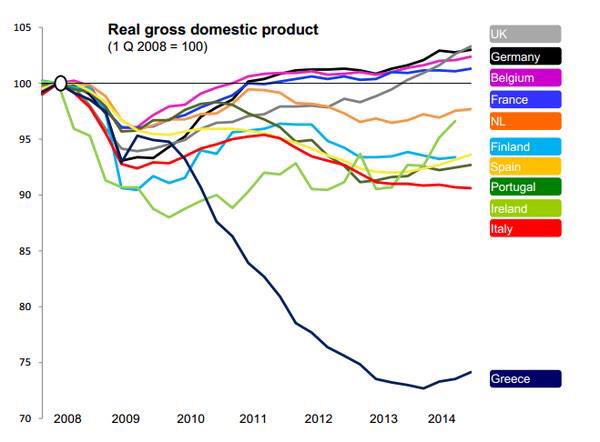
Δλδ νταξ ας πουμε οτι ο συριζα φταιει για ολα, οι ευρωπαιοι τοσο γιδια που δεν καταλαβαινουν οιτ αυτο το διαγραμμα σημαινει βομβα μεγατονων που με ή χωρις συριζα καποτε θα σκασει?
Άβαταρ μέλους
By IKE
#129774 Η τρόικα κάνει προτάσεις για να αναστραφεί αυτό που βλέπεις στο διάγραμμα, οι ελληνικές κυβερνήσεις κάνουν ακριβώς το ανάποδο, ποιοι είναι τα γίδια λοιπόν?
Άβαταρ μέλους
By Zorz
#129775
nass έγραψε:Δυστυχώς οι πολίτες ήρθαν between a rock and a hard place -και αυτό σε καμία περίπτωση δεν είναι τιμητικό για την παρούσα κυβέρνηση.


Πριν κάτι μέρες, μου είχες γράψει ότι η πολιτική είναι η τέχνη του εφικτού. Μακάρι να είχες δίκιο, αλλά bollocks. Ο λόγος που ήμουν τόσο απαισιόδοξος, είναι ότι οποιαδήποτε από τις 2 επιλογές είναι καταστροφική. Ακόμα και αν αποδεχόμασταν (συμφωνούσαμε/υποκύπταμε, βάλε όποιο ρήμα θέλεις) αυτά που μας ζητούσαν (και τα εφαρμόζαμε 100%), το αποτέλεσμα θα ήταν πάλι self-defeating.

Πραγματικά οι ιστορικοί του μέλλοντος θα γράφουν για την εποχή μας και τη |λογοκρισία| που μας δέρνει συλλογικά, και εμάς ως λαό, και τις διαδοχικές κυβερνήσεις μας (συμπεριλαμβανόμενης και της τωρινής), και τους απέναντι. :vava:
Άβαταρ μέλους
By Corto Maltese
#129776
IKE έγραψε:Η τρόικα κάνει προτάσεις για να αναστραφεί αυτό που βλέπεις στο διάγραμμα, οι ελληνικές κυβερνήσεις κάνουν ακριβώς το ανάποδο, ποιοι είναι τα γίδια λοιπόν?

Βλέπεις ένα νουμεράκι που γράφει 2010. Τραβάς μία γραμμούλα ίιιιιιιιιιιιιιισα πάνω και βρίσκεις που τέμνει τη μπλε σκούρα γραμμη. Εκεί είναι που άρχισε να κάνει προτάσεις η τρόικα. Ακόμα και εσύ μπορείς να δεις το αποτέλεσμα. Και ίσως γυρίσεις και πλευρό.