Για θέματα γενικού ενδιαφέροντος, εκτός μηχανοκίνητων...
Άβαταρ μέλους
By The Ace
#155379
Χρήστος Λάππας έγραψε:
Curiosity Finds a 'Floating Spoon' on Mars
SEP 1, 2015 05:32 PM ET // BY IAN O'NEILL

Εικόνα

...."There is no spoon...." NASA tweeted on Wednesday.

Πηγή: http://news.discovery.com/space/curiosi ... 150901.htm


Αν μη τι άλλο, τα παληκάρια εκεί πέρα ξέρουν πως και τι να πουν για να κάνουν έξυπνο χιούμορ για αυτούς που τους διαβάζουν :thumbsup:
Άβαταρ μέλους
By Χρήστος Λάππας
#161140
New Pluto pics show weird terrain shaped by alien ‘water’ cycle

Εικόνα
nh-apluto-wide-9-17-15-finalNASA/JHUAPL/SwRI

Pluto has again stunned researchers in the latest pictures downloaded from NASA’s New Horizons probe. The images, taken just 15 minutes after the spacecraft’s closest approach to the dwarf planet on July 14, reveal incredible mountain ranges and glaciers that look surprisingly like Earth.

In the first picture, above, New Horizons is looking back at Pluto, towards the sun, allowing the probe’s camera to spy the layered haze of the tiny world’s tenuous nitrogen atmosphere. The image was taken from a distance of 18000 kilometres and stretches 1250 kilometres across, around half the width of the entire dwarf planet.

Εικόνα
nh-apluto-mountains-plains-9-17-15NASA/JHUAPL/SwRI

This second image zooms in on the central region of the first and you can really see these 3.5 kilometre high mountains popping out. They lie just to the left of Pluto’s now famous heart-shaped ice plain, informally known as Sputnik Planum.

“This image really makes you feel you are there, at Pluto, surveying the landscape for yourself,” said New Horizons lead scientist Alan Stern. “But this image is also a scientific bonanza, revealing new details about Pluto’s atmosphere, mountains, glaciers and plains.”

Εικόνα
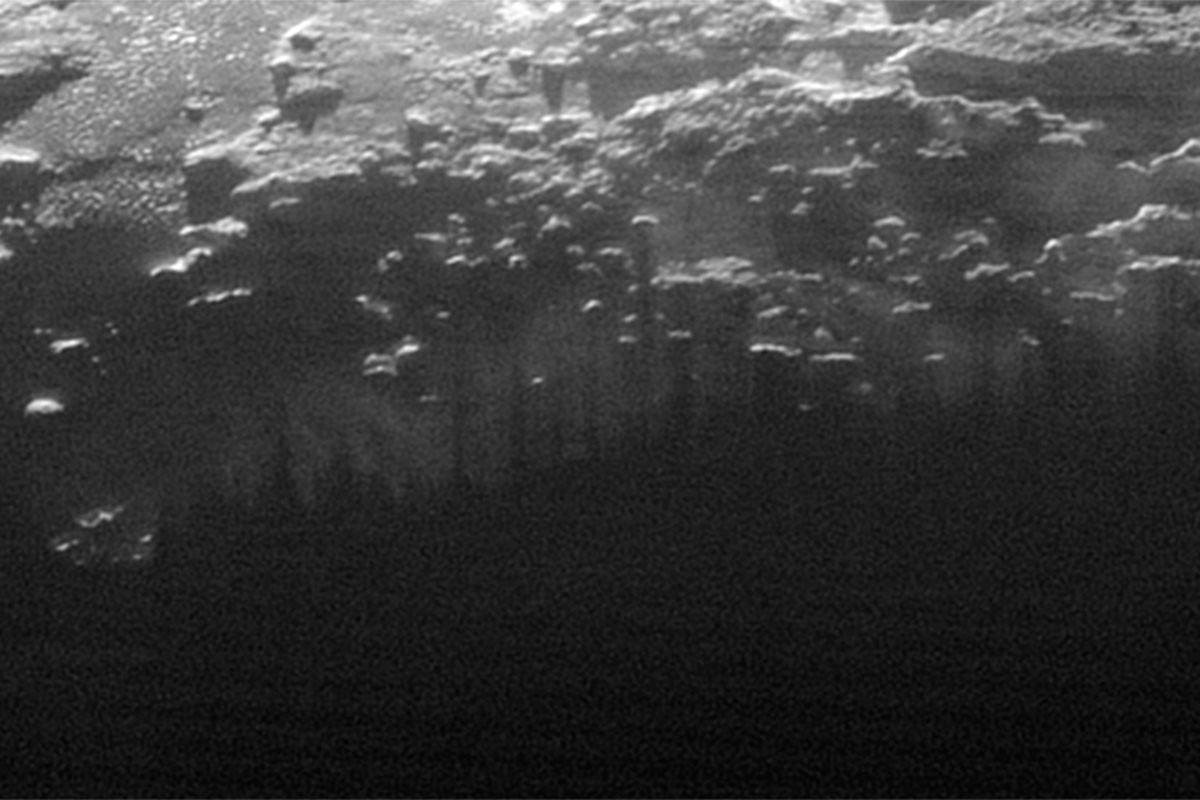
nh-apluto-low-haze-9-17-15-updatedNASA/JHUAPL/SwRI

Zooming further reveals a low-lying fog illuminated by the setting sun. That suggests Pluto’s weather changes daily, just like on Earth. The team now believe that Pluto has a “water” cycle similar to Earth’s, but with exotic ices like frozen nitrogen, rather than water.

“We did not expect to find hints of a nitrogen-based glacial cycle on Pluto operating in the frigid conditions of the outer solar system,” said team member Alan Howard. “Driven by dim sunlight, this would be directly comparable to the hydrological cycle that feeds ice caps on Earth, where water is evaporated from the oceans, falls as snow, and returns to the seas through glacial flow.”

https://www.newscientist.com/article/ne ... LOBAL-hoot
Άβαταρ μέλους
By Χρήστος Λάππας
#161152
Cassini finds global ocean in Saturn’s moon Enceladus
Researchers found that the magnitude of the moon's slight wobble, as it orbits Saturn, can only be accounted for if its outer ice shell is not frozen solid to its interior.
By NASA | Published: Tuesday, September 15, 2015

Εικόνα
Illustration of the interior of Saturn's moon Enceladus showing a global liquid water ocean between its rocky core and icy crust. Thickness of layers shown here is not to scale.
NASA/JPL-Caltech

A global ocean lies beneath the icy crust of Saturn's geologically active moon Enceladus, according to new research using data from NASA's Cassini mission.

Researchers found that the magnitude of the moon's slight wobble, as it orbits Saturn, can only be accounted for if its outer ice shell is not frozen solid to its interior, meaning a global ocean must be present.

The finding implies the fine spray of water vapor, icy particles, and simple organic molecules Cassini has observed coming from fractures near the moon's south pole is being fed by this vast liquid water reservoir.

Previous analysis of Cassini data suggested the presence of a lens-shaped body of water, or sea, underlying the moon's south polar region. However, gravity data collected during the spacecraft's several close passes over the south polar region lent support to the possibility the sea might be global. The new results, derived using an independent line of evidence based on Cassini's images, confirm this to be the case.

"This was a hard problem that required years of observations and calculations involving a diverse collection of disciplines, but we are confident we finally got it right," said Peter Thomas from Cornell University in Ithaca, New York.

Cassini scientists analyzed more than seven years' worth of images of Enceladus taken by the spacecraft, which has been orbiting Saturn since mid-2004. They carefully mapped the positions of features on Enceladus — mostly craters — across hundreds of images in order to measure changes in the moon's rotation with extreme precision.

As a result, they found Enceladus has a tiny but measurable wobble as it orbits Saturn. Because the icy moon is not perfectly spherical — and because it goes slightly faster and slower during different portions of its orbit around Saturn — the giant planet subtly rocks Enceladus back and forth as it rotates.

The team plugged their measurement of the wobble, called a libration, into different models for how Enceladus might be arranged on the inside, including ones in which the moon was frozen from surface to core.

"If the surface and core were rigidly connected, the core would provide so much dead weight the wobble would be far smaller than we observe it to be," said Matthew Tiscareno from the SETI Institute in Mountain View, California. "This proves that there must be a global layer of liquid separating the surface from the core."

The mechanisms that might have prevented Enceladus' ocean from freezing remain a mystery. Thomas and his colleagues suggest a few ideas for future study that might help resolve the question, including the surprising possibility that tidal forces due to Saturn's gravity could be generating much more heat within Enceladus than previously thought.

"This is a major step beyond what we understood about this moon before, and it demonstrates the kind of deep-dive discoveries we can make with long-lived orbiter missions to other planets," said Carolyn Porco from the Space Science Institute in Boulder, Colorado. "Cassini has been exemplary in this regard."

The unfolding story of Enceladus has been one of the great triumphs of Cassini's long mission at Saturn. Scientists first detected signs of the moon's icy plume in early 2005 and followed up with a series of discoveries about the material gushing from warm fractures near its south pole. They announced strong evidence for a regional sea in 2014, and more recently, in 2015, they shared results that suggest hydrothermal activity is taking place on the ocean floor.

Cassini is scheduled to make a close flyby of Enceladus on October 28 in the mission's deepest-ever dive through the moon's active plume of icy material. The spacecraft will pass a mere 30 miles (49 kilometers) above the moon's surface.

http://www.astronomy.com/news/2015/09/c ... -enceladus
Άβαταρ μέλους
By Χρήστος Λάππας
#161154 Πως δείχνεις το ηλιακό σύστημα σε σωστή κλίμακα; Βρίσκεις ένα αρκετά μεγάλο ανοιχτό χώρο. Ένα ΠΟΛΥ μεγάλο ανοιχτό χώρο!

Άβαταρ μέλους
By The Ace
#165690 NASA to Announce Mars Mystery Solved :hmmm:

NASA will detail a major science finding from the agency’s ongoing exploration of Mars during a news briefing at 11:30 a.m. EDT on Monday, Sept. 28 at the James Webb Auditorium at NASA Headquarters in Washington. The event will be broadcast live on NASA Television and the agency's website.
Άβαταρ μέλους
By Corto Maltese
#168353 Ρε γατάκια ποιο νερό στον Άρη και τον Απόλλωνα Καλαμαριάς; Εδώ συμβαίνουν μικρά μπιγκ μπαγκ στο νομό Ηλείας :rtfm: :yahoo: :dizzy: :help: :s_drinks

Άβαταρ μέλους
By markvag
#190621 Ίσως η επόμενη λέξη της τεχνολογίας στην εξερεύνηση του διαστήματος. Διαστημόπλοια τόσο μικρά που στην τσέπη σου χωράνε μερικά...

Πως;;;

Έτσι:


Εν τάχει, πολύ μικρά διαστημόπλοια (2χ2 εκ) προωθούμενα από κινητήρα ιόντων... Πάμφθηνα και δεν σε νοιάζει αν μερικά καταστραφούν / χαλάσουν στην πορεία. Μπορείς να στείλεις χιλιάδες...

Ενδιαφέρον...
Άβαταρ μέλους
By g8777
#198811

CEO και δε συμμαζευεται υπαρχουν πολλοι, οραματιστες/εφευρετες ελαχιστοι.

Θυμασαι Elon που σε πρηζαμε με τον IKE; :rtfm: :rtfm: :rtfm: